For Canada, 2025 was supposed to be a challenging but fairly optimistic year. Inflation had slipped below the 2% headline CPI target , and mortgage rates were rumoured to follow suit. In April, the federal election also loomed, bringing with it a sense of political renewal.
For all this positivity was worth, however, there was still a huge elephant in the room: the upcoming trade war between two countries that have considered each other close allies, at least when it came to imports and exports.
2025 then became the year of Trump tariffs.
Tariff, Trump’s favourite word in the English language , meant steep new duties on steel, aluminum, and automobiles for Canadian businesses. Almost overnight, the trade war had seemingly upended the playing field. Exporters scrambled to adjust to the higher costs, supply chains felt the squeeze, and investors started facing some tough decisions.
In this article, we’ll break down what’s changed, what industries have felt the biggest pinch, and what types of businesses are still offering stable opportunities for buyers.
It’s not all doom and gloom, but it is time to tread carefully.
Understanding Trump’s New Tariffs on Canada
For Canadian businesses, especially those in export-heavy sectors like metals and automotive, the new rules have left little untouched. Tariffs have reshaped everything from pricing strategy to long-term investment plans.
Before getting into the minutia of the impact, let’s quickly take a look at the timeline:

Image: Created by Author
These key dates help explain why Canadian businesses had so little time to adjust. These announcements came hard and fast, and the tariffs hit even faster.
The Return of Steel and Aluminum Tariffs
Let’s begin with the heavyweights. Literally. On March 12th, 2025, the U.S. reinstated Trump steel tariffs and applied them at 25% across the board . This time though, aluminum was also included. Canada exports around CAD $35 billion worth of steel and aluminum to the U.S. every year.
That’s not exactly pocket change, but an entire industrial backbone. With such steep tariffs now in place, Canadian producers are either absorbing the costs or losing business to cheaper suppliers.
Trump Auto Tariffs and Their Wider Reach
Next came the auto industry’s turn at the tariff wheel. As of April 3, all finished vehicles venturing across the Canadian border now face a duty. It has been rumoured that the 25% tariff on Canadian vehicles could rise even higher . On May 3rd, automotive parts are set to follow suit . These auto tariffs have really hit a nerve, as 93% of Canadian-made vehicles are exported to the U.S. every year.
In practical terms, this means that nearly every car rolling out of an Ontario plant is suddenly a quarter more expensive by the time it reaches buyers in the U.S. These Trump tariffs Canada must face could lead to production cuts, job losses, or worse. We could see entire operations moving south to avoid the border toll. There are signs that no one is exactly rushing to move any time soon.
The Reciprocal Tariff Baseline and Canada’s Exemption
On April 2, Trump unveiled a 10% “reciprocal tariff” baseline that was meant to mirror what other countries charge the US. In a rare moment of leniency, Canada (and Mexico) were spared. However, this only applied to USMCA-compliant goods .
It was of little comfort to Canadian auto, steel, and aluminum companies that still fell under separate orders and were not exempt.
Canada did avoid getting lumped in with the rest of the world, but the relief only went so far. For businesses shipping out non-metal, non-vehicle products, it was a close call. For the rest? The tariff train might have already left the station.
Below is the current situation for Canadian businesses:
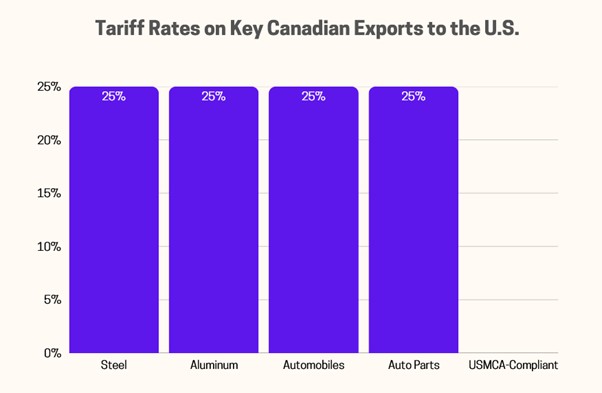
Image: Created by Author
What does the future hold for Canadian tariffs? It’s difficult to predict as Trump’s policies can change at the drop of a hat. Next, we’ll take a look at what could possibly be on the horizon for other sectors already hit with the duty and others that haven’t fallen under the exemptions.
How the Tariffs Are Raising Business Costs
The ripple effects of the Trump tariffs are hitting Canadian businesses from every angle. This is happening not only at the border but deep into supply chains that have only just recovered from the impact of the COVID pandemic.
Below, we’ll explore the often unseen consequences of this economic trade war.
Exporters Are Losing Their Price Edge
For exporters of steel, aluminum, and auto parts, the new 25% tariffs are a direct blow to competitiveness. Canadian products arriving on U.S. soil are now significantly more expensive than they were only a few months ago.
In industries with already tight profit margins like manufacturing, many simply can’t afford to absorb the cost. They’re now faced with a tough choice: raise prices and lose customers, or slash margins and hope they can hang on.
Importers Face Higher Prices and Supply Chain Disruptions
It’s not only exporters who are feeling the pressure. Import businesses in Canada that supply Canadians with much-loved U.S. products now face pressure too. This comes not only from rising costs thanks to Canada’s reciprocal tariffs but from Canadians themselves who are fiercely buying and promoting Canadian-made products.
Consumers Are Paying More at the Checkout
For everyday Canadians, the tariffs and tit-for-tat counter-tariffs translate into one thing: Sticker shock. New car prices are climbing, grocery costs are edging higher and higher, and inflation once again threatens to hinder the economy.
This is because tariffs are just taxes with a fancy label slapped on them. Canadian retailer Loblaw probably puts this best by explaining a scenario with a product Canadians know all too well:
Coffee shipped from Vietnam already attracts a 46% tariff. It’s roasted in the U.S., then sent to Canada where the reciprocal 25% tariff kicks in, raising the price of a brew even higher. Essentially every $1 that was once spent on coffee, now costs around $1.82 because of tariffs.
Business Confidence and Employment Are Taking a Hit
The constant back-and-forth tariff threat has created a volatile business environment. Companies are putting expansion plans on hold, freezing hiring, and preparing for tough times ahead.
Some sectors are already seeing significant job losses, with over 30,000 jobs lost in March alone , directly tied to US tariffs. In response, the Canadian government rolled out CAD $6.5 billion in support packages , including the Large Enterprise Tariff Loan Facility ( LETL ) for eligible businesses.
Industries That Might Weather the Tariff Storm
Despite all the noise around tariffs and trade wars, not every single Canadian industry is impacted to the level of those mentioned above. In fact, many are remaining remarkably stable.
For those looking to purchase Canadian businesses, operations that rely on local customers, digital services, or export beyond the U.S. are viable and profitable options.
Let’s take a look at a few business sectors that offer a welcome dose of predictability amid the Trump tariffs.
Service-Based Businesses (Retail, Hospitality, Food)
Tariffs apply to products crossing the border. They don’t apply to the convenience store down the road or the boutique hotel on the edge of Banff. These businesses earn their revenue locally and serve loyal domestic customers. This makes them largely immune to direct trade impacts.
Yes, inflation may push up some supplier costs, but with smart management, margins can be protected. Some tourism operators may even benefit from a perceivably weaker Canadian dollar, as more international visitors shy away from the U.S. and set their sights on Lake Louise and Niagara Falls instead.
Technology and Software
The Canadian tech sector keeps on thriving. This is because SaaS , app development , and IT consulting services aren’t moving physical goods, so there’s nothing to tariff.
Even cross-border sales to U.S. clients remain untouched for now. Hardware and semiconductor manufacturers are likely to feel the heat, but any business focusing solely on digital solutions might just remain out of the tariff spotlight.
Real Estate and Construction
This sector is driven mostly by local economic conditions. Things like interest rates, population growth, immigration, and housing demand tend to affect it more than tariffs. Tariffs will likely affect the cost of building materials, but a lot of Canada’s construction supply chain is domestic.
Real estate firms , construction contractors , and property services have little exposure to U.S. trade risks.
Resource Industries with Global Buyers
Canada’s mining, energy, and agri-export sectors, especially those shipping to Asia and Europe, are so far untouched. This offers a rare point of certainty for businesses involved in the export and production of oil-based petrochemicals. Businesses that specialize in oil and gas infrastructure, oilfield service, and consulting are likely to weather the tariff storm for now.
Is Now Still a Good Time to Buy a Business in Canada?
Despite the trade turbulence, many sectors in Canada remain rock steady. Canada itself is positioned well for growth despite the sanctions, and the country's continued resilience in the face of significant trade tariffs is a testament to Canada’s strong and thriving economy.
Service-based businesses, tech firms, retail operations, and any business focused on local demand are still seeing steady opportunities.
While it’s smart to tread carefully during this time, there’s no reason to sit on the sidelines. For those looking to invest in a stable business, Canada has many sectors to explore that are less exposed to U.S. tariffs.
You can browse these businesses today on the BFS website marketplace . For more insights into buying and owning a business in Canada, check out the BFS business guides and start investing today.
FAQs
What tariffs has Trump announced for Canada?
Trump has imposed 25% tariffs on Canadian steel, aluminum, vehicles, and auto parts. Many goods still remain tariff-free under USMCA rules, but many major sectors are directly affected.
Why is Trump putting tariffs on Canada?
Trump argues that placing tariffs on friendly countries like Canada is required to protect U.S. industries and respond to what he calls “unfair trade practices”. Trump has also linked tariffs to border security concerns in what he calls the “immigration and fentanyl” tariffs, targeting primarily Canada and Mexico.
When do Trump’s tariffs start?
The 25% tariffs on metals and minerals took effect on March 12, 2025. Automotive parts and vehicle tariffs began rolling out on April 3, 2025. There is currently no set date for the measures to end.
What businesses in Canada will be unaffected by tariffs?
Any business that focuses on domestic services is largely untouched by tariffs. These include sectors like hospitality, real estate, retail, and technology. Companies that export to non-U.S. markets are also much less exposed.