Family run businesses are often described in extremes: either the perfect lifestyle business or a recipe for conflict. In reality, most fall somewhere in between. For couples and families thinking about buying a business together, the real questions are practical: Can we work together day to day? Will the business support our family long-term? And how do we eventually step away?
This real-world story follows a husband and wife who did exactly that. They purchased an established hospitality business, ran it as a family for several years, and then exited successfully. Along the way, their experience touches on topics many prospective buyers actively research – from family business ideas and family business succession planning, to exit strategy and business exit strategy preparation.
Although this story focuses on one family, the lessons are relevant to anyone exploring family run businesses in Canada.
From careers to a family business idea
In 2016, Nathalie and her husband Martin were living in Québec City. Nathalie worked as a nurse, while Martin was an IT Director. Like many couples researching family business ideas, they wanted to work together, regain control over their time, and build something their family could be part of.
They were also looking for a lifestyle change. After years of watching both property and business listings, they identified an opportunity in Nova Scotia that matched their financial goals and family priorities.
Through BusinessesForSale.com, they discovered Upper Clements Cottages Ltd, a family-run caravan park and holiday accommodation business located near the Bay of Fundy.
Taking over an existing family run business
Upper Clements had originally been founded in 2000 by the Mailman family, who operated the business alongside their children for many years. When Nathalie and Martin took over, the transaction felt less like a simple sale and more like a handover – a dynamic often seen in family business succession planning, even when the families are unrelated.
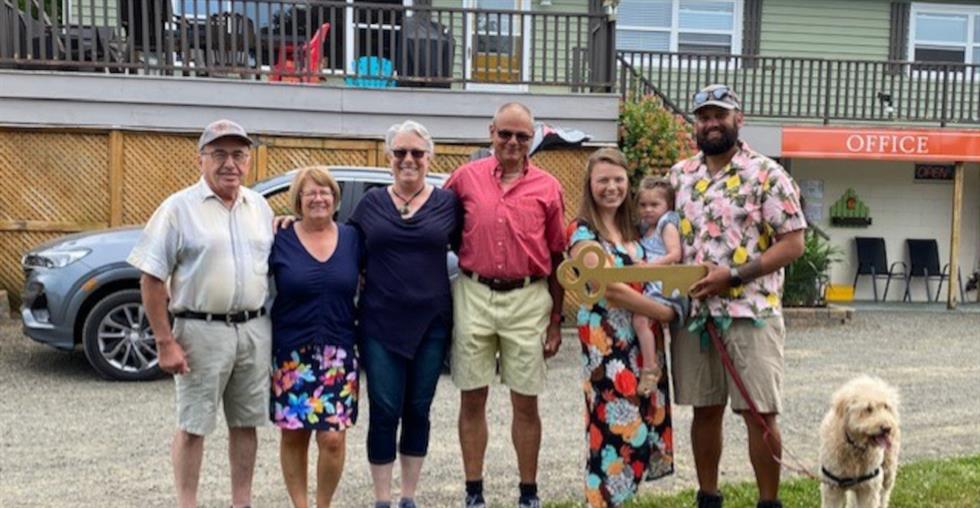
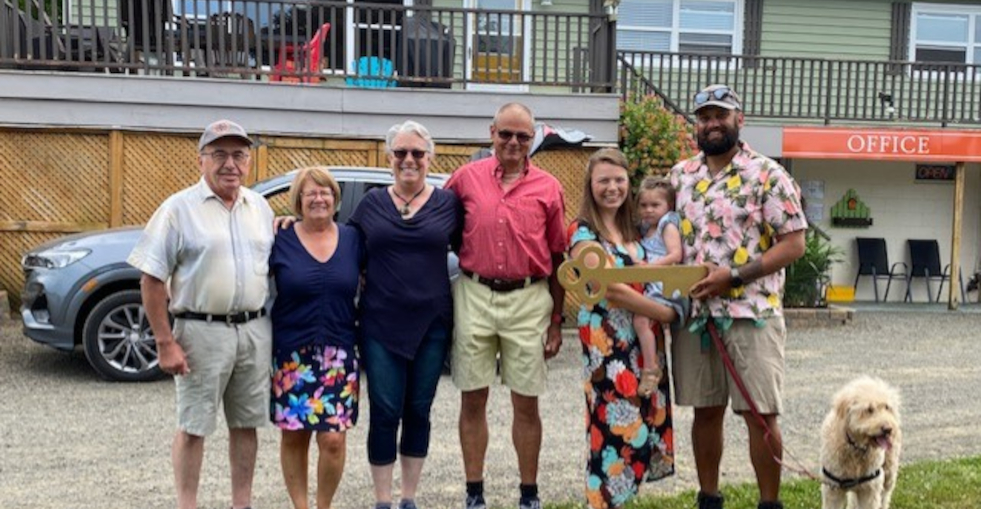
On completion day, the Mailmans presented a large ceremonial wooden key to mark the transition. It symbolised continuity and care, setting the tone for a respectful relationship that extended beyond the sale.
This highlights a key advantage of buying family run businesses: sellers are often emotionally invested and want to see what they built continue, not simply change hands.
Running the business as a family
The business included seven year-round rental cottages, more than 30 RV and caravan sites, and shared facilities such as a swimming pool and playground. Nathalie and Martin relocated with their family and became hands-on owner-operators.
Running a family business quickly proved demanding. Workloads were seasonal, decisions constant, and success depended on strong communication. Rather than splitting responsibilities evenly, they leaned into their strengths. Martin focused on systems, data and pricing, while Nathalie managed day-to-day operations and guest experience.
This clarity is often what makes a husband and wife business partnership in Canada successful: trust already exists, but roles still need structure.
Competing digitally in hospitality
Marketing was one of the earliest challenges. Like many small hospitality operators, Upper Clements was competing not only with other campgrounds, but also with platforms such as Airbnb and short-term rentals.
Martin used his technical background to analyse booking performance, identify the most effective platforms, and focus spend where returns were strongest. Rather than trying to outspend competitors, the couple prioritised efficiency – improving online bookings, simplifying payments, and strengthening visibility through tourism websites and regional partnerships.
For anyone considering a hospitality business for sale, digital visibility is now essential, even in rural or seasonal locations.
Resilience through uncertainty
The Covid-19 pandemic tested hospitality businesses across Canada. Upper Clements fared better than many due to its location and adaptability. Nathalie’s healthcare background allowed the business to implement strict cleaning protocols and reassure guests during an uncertain period.
While revenues were impacted, the business remained viable. This reinforced a key advantage of family run businesses: decisions can be made quickly, without layers of approval, drawing on real-world experience from outside the business itself.
Planning the exit from day one
After eight years of ownership, and with their daughter preparing to leave home, Nathalie and Martin decided it was time to sell. Importantly, this wasn’t a rushed decision. From the beginning, they had treated the business as an asset with a defined lifecycle.
This is where exit strategy thinking becomes critical. Too many owners delay business exit strategy planning until exhaustion sets in. In contrast, Upper Clements had been maintained, documented and optimised with saleability in mind.
They listed the business on BusinessesForSale.com in late 2023, expecting the process to take several years. Instead, they secured a buyer within months, completing the sale in just over six months. Preparation, timing and visibility all played a role.
Passing the business to another family
The buyers were another family, the Kamals, who relocated with their daughter in 2024. Once again, ownership transferred not just as a transaction, but as the continuation of a family run legacy.
This family-to-family transition reflects a growing trend in the small business market and highlights the importance of informal family business succession planning, even outside traditional inheritance.
At completion, Nathalie and Martin passed on the ceremonial wooden key – a tradition now spanning three families.
Life after the family business
Today, Nathalie and Martin are semi-retired and remain active in their local community. Nathalie works part-time as an interpreter with Parks Canada, while Martin continues to work locally.
Looking back, Nathalie says that running a family business strengthened their relationship rather than strained it. Clear communication, shared goals and realistic expectations made all the difference.
Why family run businesses attract buyers
Family run businesses continue to appeal to buyers because they offer something traditional employment rarely does: shared ownership, flexibility, and the opportunity to build long-term value together. A husband and wife business partnership – or any other kind of family business partnership - in Canada can be particularly effective when skills are complementary and roles are clearly defined.
For many buyers, purchasing an existing family run business is more attractive than starting from scratch. There is already a customer base, established operations and immediate cash flow. This is especially true in hospitality, where reputation, reviews and local knowledge are critical.
As a result, interest in hospitality businesses for sale and lifestyle-driven assets continues to grow across Canada.